Wednesday, 31 July 2019

Saturday, 19 November 2011
Our new housemates (again)
First, a little history:
We have fish. I like fish. They are pretty easy to take care of, cheap to own, and can provide hours of entertainment to people with attention spans like mine. Since getting my tank, it has been populated with the following (in order):
He has then been observed chasing the three remaining fish around the tank, haranguing and harassing them (at least, to my mind), and generally being a big bully. Stern words have been issued, but he appears to not understand, or not care. We have resorted to alternative measures. Allow me to introduce Totoro and Lupé.
Totoro is a Japanese Fighting Fish, although the term is something of a misnomer - he's actually not agressive, unless there is another Fighting Fish in the tank. Lupé is a mosaic corydora, introduced primarily to eat the scraps that fall to the bottom, and keep the tank a bit cleaner.
The hope is that the introduction of these two slightly larger fish will serve to stop Zebra thinking he is king of the tank, and also make it a bit prettier - Totoro is a lovely red, and Lupé's spots complement Zebra's stripes wonderfully.
We have fish. I like fish. They are pretty easy to take care of, cheap to own, and can provide hours of entertainment to people with attention spans like mine. Since getting my tank, it has been populated with the following (in order):
- A black guppy named Black (deceased)
- A yellow guppy named Yellow (deceased)
- Two harlequin rasboras named Thing One and Thing Two
- A zebra danio named Zebra - officially Judy's
- Two tetras - still currently unnamed (one deceased)
- Two crabs named Houdini and Blaine because of their affinity for trying to get out of the tank - officially Josh's (deceased)
He has then been observed chasing the three remaining fish around the tank, haranguing and harassing them (at least, to my mind), and generally being a big bully. Stern words have been issued, but he appears to not understand, or not care. We have resorted to alternative measures. Allow me to introduce Totoro and Lupé.
 |
| Lupé |
 |
| Totoro, with tetra and Thing Two in background |
The hope is that the introduction of these two slightly larger fish will serve to stop Zebra thinking he is king of the tank, and also make it a bit prettier - Totoro is a lovely red, and Lupé's spots complement Zebra's stripes wonderfully.
Saturday, 27 August 2011
What I've been up to this week
I thought I might just write about some of my exciting job experiences this week. This is a geeky one.
I love my job. I work for a Christian charity called Adventure Plus as both an activity instructor and the IT Systems Administrator. As I have no subordinates on the IT side of things, this basically makes me the whole of the IT department, which can be any of fun, exciting, liberating, disheartening, horrific, terrifying, lonely, intense, hectic, stressful, rewarding and impressive on any given day. It's usually some combination of the above. The main reason for this is that I can count my IT qualifications without having to start counting. I have none. What I do have is a wealth of experience, an understanding of how technology works, a brain and a willingness to learn. This means that I go into problems with a good idea of what I want to achieve, a reasonable idea of what that will entail, and sometimes a vague idea of exactly how complicated it will be.
This week, I set up a new Primary Domain Controller for our office systems.
In layman's terms, that's the bit that makes logging on to a computer work. It means the computers know who you are, whether your username and password are correct, and what to do with that information (usually allow you some degree of access, set up a couple of shared drives, and apply some default settings). Our current server was originally set up before I started at A+, and runs Microsoft Windows Server 2003. I have no prior knowledge of Windows servers, Active Directory, roaming profiles, Group Policy, or any of a number of other things it pertains to do. This means that when something doesn't work, it takes me an age to figure out why and attempt to fix it. Also, it transpires that we don't have enough licences to allow all our computers to connect at once.
The new server runs Ubuntu 10.04 (Linux) and Samba 4.0, which is currently in heavy development. There is no sign of Windows or Microsoft anywhere on the new server, however I can log in as a Domain Administrator and use exactly the same management tools that I've been using on Windows from any computer that's part of my test network.
Roaming profiles work.
Group policies work.
Login and update scripts work.
Syncing the time works.
I even joined an Ubuntu desktop to the domain to see if I could. I could.
In one week, I have gone from having a computer with nothing on it to a fully working server that is more functional than our current Windows server. The operating system, and all software used so far, are not only free, but open source, and developed by communities of individuals. The running costs, from a software and licence viewpoint, are zero.
In one week, I have learned more about how to make Samba work as a PDC than in over two years attempting to learn the nuances of Microsoft Server 2003.
Now, I'm certainly not saying that there is anything fundamentally wrong with the setup that is in place. What I am trying to point out is that sometimes all the information you have about how to go about something is wrong, and actually there are simpler, better solutions if you just look for them.
Just to finish, I do not mean this to come across as arrogant. I am under no illusions as to my own abilities, and I've worked with Linux, and command line tools before. I had blocked out the next three weeks to get to the point I am now at with the new server. I was expecting to hit massive problems. I owe an awful lot of thanks to the helpful people on the #samba-technical IRC channel, and the people who wrote the HOWTO guide that got me most of the way there. I'm off canoeing down the Thames for a few days next week, and it's great to know that I'll be coming back to a shiny working server, rather than one in tatters.
I love my job. I work for a Christian charity called Adventure Plus as both an activity instructor and the IT Systems Administrator. As I have no subordinates on the IT side of things, this basically makes me the whole of the IT department, which can be any of fun, exciting, liberating, disheartening, horrific, terrifying, lonely, intense, hectic, stressful, rewarding and impressive on any given day. It's usually some combination of the above. The main reason for this is that I can count my IT qualifications without having to start counting. I have none. What I do have is a wealth of experience, an understanding of how technology works, a brain and a willingness to learn. This means that I go into problems with a good idea of what I want to achieve, a reasonable idea of what that will entail, and sometimes a vague idea of exactly how complicated it will be.
This week, I set up a new Primary Domain Controller for our office systems.
In layman's terms, that's the bit that makes logging on to a computer work. It means the computers know who you are, whether your username and password are correct, and what to do with that information (usually allow you some degree of access, set up a couple of shared drives, and apply some default settings). Our current server was originally set up before I started at A+, and runs Microsoft Windows Server 2003. I have no prior knowledge of Windows servers, Active Directory, roaming profiles, Group Policy, or any of a number of other things it pertains to do. This means that when something doesn't work, it takes me an age to figure out why and attempt to fix it. Also, it transpires that we don't have enough licences to allow all our computers to connect at once.
The new server runs Ubuntu 10.04 (Linux) and Samba 4.0, which is currently in heavy development. There is no sign of Windows or Microsoft anywhere on the new server, however I can log in as a Domain Administrator and use exactly the same management tools that I've been using on Windows from any computer that's part of my test network.
Roaming profiles work.
Group policies work.
Login and update scripts work.
Syncing the time works.
I even joined an Ubuntu desktop to the domain to see if I could. I could.
In one week, I have gone from having a computer with nothing on it to a fully working server that is more functional than our current Windows server. The operating system, and all software used so far, are not only free, but open source, and developed by communities of individuals. The running costs, from a software and licence viewpoint, are zero.
In one week, I have learned more about how to make Samba work as a PDC than in over two years attempting to learn the nuances of Microsoft Server 2003.
Now, I'm certainly not saying that there is anything fundamentally wrong with the setup that is in place. What I am trying to point out is that sometimes all the information you have about how to go about something is wrong, and actually there are simpler, better solutions if you just look for them.
Just to finish, I do not mean this to come across as arrogant. I am under no illusions as to my own abilities, and I've worked with Linux, and command line tools before. I had blocked out the next three weeks to get to the point I am now at with the new server. I was expecting to hit massive problems. I owe an awful lot of thanks to the helpful people on the #samba-technical IRC channel, and the people who wrote the HOWTO guide that got me most of the way there. I'm off canoeing down the Thames for a few days next week, and it's great to know that I'll be coming back to a shiny working server, rather than one in tatters.
Wednesday, 6 April 2011
By the way...
The company I work for have a sponsored event going on next week.
I have another blog where I'll be writing about it.
There's also a Twitter feed which will have updates.
Also, I've created a clever map that show where we'll be (it'll be tracking my phone down the river).
You could sponsor me if you like.
I have another blog where I'll be writing about it.
There's also a Twitter feed which will have updates.
Also, I've created a clever map that show where we'll be (it'll be tracking my phone down the river).
You could sponsor me if you like.
Thursday, 17 March 2011
Microsoft Office 2010
So I've spent most of the day installing Office 2010 on all our work PCs, then getting people to test it, mainly by carrying on with what they were doing previously on OpenOffice 3. The move back to MS Office was a management decision to standardise across the office, originally asking if it was possible to 'standardise to different versions of Microsoft,' leading me to believe that some people either a) aren't familiar with what 'standardise' means, or b) are under the impression that so long as it's from the same company, it's the same product. I'll find a suitable car analogy soon enough, I'm sure.
Anyhow, having sourced Office 2010 Standard edition at a Charity discount rate and played with it for a day or so, I have to say... I don't hate it.
This will come as something as a surprise to most people who know me, and so I think I need to explain myself.
I dislike being told that I should buy expensive things because "they're better" or because "you get what you pay for." I consider myself to be very discerning, fairly intelligent, and capable of making my own informed decisions. To borrow a line from the Matrix, I believe "you have to make up your own damn mind" about many things. My past experiences with Microsoft have given me the view that their software is a) overpriced for what you get, and b) not substantially better than what you can get for free. However, I think somewhere in the last decade they've realised they need to step up their game to compete with open source software. Office 2010 seems responsive, well thought out, flexible, and, dare I say, worth what we paid for it.
But therein lies the one remaining problem: I was buying in bulk, and getting a hefty charity discount. In fact, the suite we've got includes the same software as the Home and Business version, for less than the retail price of the Student version. Is it worth £190? I don't think so. Do I think that, at the price we paid, it was a good investment? Definitely. Read into that what you will.
Anyhow, having sourced Office 2010 Standard edition at a Charity discount rate and played with it for a day or so, I have to say... I don't hate it.
This will come as something as a surprise to most people who know me, and so I think I need to explain myself.
I dislike being told that I should buy expensive things because "they're better" or because "you get what you pay for." I consider myself to be very discerning, fairly intelligent, and capable of making my own informed decisions. To borrow a line from the Matrix, I believe "you have to make up your own damn mind" about many things. My past experiences with Microsoft have given me the view that their software is a) overpriced for what you get, and b) not substantially better than what you can get for free. However, I think somewhere in the last decade they've realised they need to step up their game to compete with open source software. Office 2010 seems responsive, well thought out, flexible, and, dare I say, worth what we paid for it.
But therein lies the one remaining problem: I was buying in bulk, and getting a hefty charity discount. In fact, the suite we've got includes the same software as the Home and Business version, for less than the retail price of the Student version. Is it worth £190? I don't think so. Do I think that, at the price we paid, it was a good investment? Definitely. Read into that what you will.
Tuesday, 1 February 2011
The evidence
Well, the Christmas cake is eaten, the snow has melted, the kids are back at school, and I've just cut together all the footage from my secret filming shenanigans. Behold!
A few questions remain:- The Wise Men reside in the loft. How did they open the loft hatch? They must be wise indeed!
- How is it they always know where the manger is? A small internal star? Incredibly precise maps? Sat-nav?
- Where did the Wise Men learn how to operate heavy (Lego) machinery?
- Why did the living room camera fail to record? Sabotage???
- What will they get up to next year?
- What should I do with this evidence now? They have committed no crime, and to try to stop them would seem (at best) unsportsmanlike.
Sunday, 26 December 2010
Concern mounts
As Christmas nears, and we plan to go touring the country visiting relatives and the like, I have some concerns regarding certain 'visitors' to the house around this time of year. I refer, of course, to our Three Wise Men from our Nativity set. These fellows, when left to their own devices, can get up to all sorts of mischief. They will use any means necessary to reach the rest of the crew. Last year I found them fashioning a rudimentary belay system to better manage the stairs - as you can imagine, with all the new housemates, I'm a little concerned as to what they'll get up to!
To that end, I'm planning on rigging the house with cameras to catch these 'wise' men red-handed, and hold a formal court proceeding if any property damage should occur. I'll post what I find on here early in the new year.
To that end, I'm planning on rigging the house with cameras to catch these 'wise' men red-handed, and hold a formal court proceeding if any property damage should occur. I'll post what I find on here early in the new year.
Sunday, 19 December 2010
Our housemates
Over the last few months, we've got several new housemates. Some are large, some small. I thought I'd introduce them all.
Harold is low maintenance, but far more interesting to look at than many other plants. He has red tips on each of his stems, where new leaves periodically appear, the red becoming the vein of the leaf itself.
I have always loved fish. I don't know why. For my birthday this year (in April), I received a fishtank from my sister, which was rather exciting. I then saved my pocket money for several months and finally, one day in September, we went to Yarnton Nurseries to visit the Oxford Aquatics Centre. I am now the proud owner of four fish: two Guppies, and two Harlequin Rasboras. Given that fish don't tend to live a long time, I've named them simply: Yellow, Black, Thing One and Thing Two (that's mainly because I can't remember that they're Rasboras without looking it up - that and the Dr Seuss connection).
I have discovered that with my cameras (the one on my phone, and an old Fuji FinePix) it's astonishingly difficult to get good close-ups of my fish, so please excuse the blurriness:
The fish are doing well, although the tank got a little green this week. I'm hoping to get an algae eater to help with the cleaning, along with a couple of other pretties (maybe some barbs or tetras), although that may be delayed given the six inches of snow on everything at the moment.
I hope you enjoyed getting to see our little family here in Witney. It may be unusual, but these guys make our house a home.
Harold the houseplant
In March of this year, our first housemate arrived from Burford Garden Company. He's a rubber plant, who requires water around once a week, to which we lovingly add some BabyBio. He's grown somewhat since his arrival, and we're wondering about taking some cuttings to give to friends.
 |  |
| Harold in March. Bottom of stairs | Harold today. Top of stairs |
Josh Jones
Josh is the largest and most mobile of our housemates, and the only one that contributes financially. Others might refer to him as a 'lodger', but that is an ugly, commercial term that in no way accurately reflects our relationship. Still others might refer to him as a 'pet', but that too barely scrapes the surface of our relationship. Josh is a friend who lives with us, and helps with cleaning, cooking, and socialising. We lived with him once before, so when he was looking to move out in September, we invited him to move here. I lost my office, but we gained so much more. If you too are inspired, adopt an Adventure Plus employee today!
 |
| Josh in a boat |
The fish
I have discovered that with my cameras (the one on my phone, and an old Fuji FinePix) it's astonishingly difficult to get good close-ups of my fish, so please excuse the blurriness:
 |
| Black and Yellow at the front of the tank. You can just make out Thing One behind |
 |
| The best shot I could get of Thing Two |
Douglas
Last year we bought a real Christmas Tree, who journeyed with us all the way to Nottingham and back over the holidays. When Christmas was over, we took him outside to enjoy a bit of fresh air, and there he thrived! This year, we've brought him back in, and he has taken up residence in Harold's usual spot (which is why Harold is now at the top of the stairs, sulking). He's only little (under four feet tall), but he's hardy and we like to think he dreams of one day being a giant tree, hence Douglas the Fir. |
| Douglas with adornments |
I hope you enjoyed getting to see our little family here in Witney. It may be unusual, but these guys make our house a home.
Saturday, 19 December 2009
Marcus Brigstocke is a genius
On this week's Now Show, Marcus Brigstocke states that the COP15 have fallen into 'a spiral of inspired inanity' that seems to have been written by Dr Seuss.
What follows is my transcript of what came next:
The delegates came and the delegates sat,
and they talked and they talked 'til their bums all went flat.
Then a delegate said of the country he knew
"We must do something quick, but just what should we do?"
So they sat again thinking and there they stayed seated,
sitting and thinking the planet's been heated.
"I think", said a delegate there from Peru,
"that we all must agree on some things we could do
like reducing emissions, at least CO2"
So they nodded and noted then vetoed and voted
and one of them stood up and suddenly quoted:
"It's the science you see that's the thing that must guide us!
When the leaders all get here they're certain to chide us".
So they sat again thinking about what to think
then decided to ponder what colour of ink
to use on the paper when they'd all agreed
to be selfless not Greedy McGreedy McGreed.
"But how do we choose just what colour to use?"
said a delegate there who'd been having a snooze.
"We need clear binding targets, definitive action,
we must all agree clearly without more distraction!"
So they sat again thinking of targets for ink
but the ink in their thinking had started to stink
and they started to think that the ink was a kink
in the thinking about real things they should think.
"If the climate needs mending then this is our chance,"
said the nuclear delegate sent there by France.
"We need to agree on one thing to agree on:
something we all want a fixed guarantee on"
"Yes," said another who thought this made sense,
"some value for carbon in dollars or pence!"
But the mention of money and thoughts of expense
had stifled the progress and things became tense.
The fellow from China with a smile on his face
said "Who put the carbon there in the first place?"
"Wasn't us" said the US then Europe did too.
Then a silence descended and no words were spoken
'til a delegate stood up, voice nervous and broken.
"Is there nothing upon which we all can decide,
'cos on Wednesday my chicken laid eggs that were fried!"
"We all like a singsong!" said the bloke from Down Under
but then the great hall was all shouting and thunder!
Policemen had entered and were wearing protesters
who they'd beaten and flattened like bloodied sou'westers.
The police had decided to down-play this crime
with 'prevention detention' and beatings in rhyme.
The greenies, who'd shouted and asked for decision
were now being battered with lethal precision!
All sick of inaction and fed up of waiting,
all tired of the endless debated placating
they'd risen up grating, berating and hating
so the police had commenced the related abating.
Ban Ki-moon put his head in another man's lap
and was last heard muttering something like "Crap."
But the chap next to him said "It's more like it's poo,"
so the great hall debated not what they should do,
but how to decide between "Crap", "Cack" and "Poo".
"It is poo!"
"It is cack!"
"It is crap!"
"We agree!"
which was written and labelled as Document Three.
"I think if we all find one thing we agree on,
then maybe Brazil will be left with a tree on."
So they sat again thinking of trees in Brazil
and of glaciers which had retreated uphill
and they thought of the poor folks whose homes were in flood
(but less of the protesters covered in blood).
They pondered the species so nearly extinct -
it's as if they all thought that these things might be linked!
"We need a solution, we need action please,"
said a lady who'd come from the sinking Maldives.
The others all nodded and said it was fact
that the time must be now not to talk but to act.
Then Obama arrived and said most rhetorical:
"Action is action, and not metaphorical".
"Wow", they all thought, "he must mean allegorical."
"I love it when Barack goes all oratorical!"
"But the problem I have is that Congress won't pass it!"
"Bugger," said Ban Ki, then "Sorry," then "Arse it."
Then Brown said "I've got it! Now how does this strike you?
It's simpler when voters already dislike you."
He suggested the EU should lead from the front
so the Mail and the Telegraph called him something very unpleasant indeed.
So the delegates stared at the text with red marks on
ignoring the gales of laughter from Clarkson.
No-one was satisfied, nobody won
'cept the morons convinced it was really the sun
...and they blew it and wasted the greatest of chances.
Instead they all frollicked in diplomat dances
and decided decisively right there and then
that the best way to solve it's to meet up again
and decide on a future that's greener and greater
not with action right now but with something else later.
Written by Marcus Brigstocke for the Now Show
Wednesday, 18 February 2009
Some wedding photos
I got married around 20 months ago. I finally got around to uploading some photos of it this month.
If you have any photos, could you please let me know? Ta.
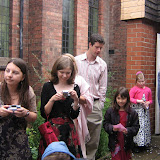 |
| Our Wedding |
If you have any photos, could you please let me know? Ta.
Monday, 2 February 2009
Why I use Linux
I've been pondering for a while on my use of a computer; what I use one for, and why. This has led me, seemingly inexorably, to a post on my OS of choice, and my reasons for it.
Allow me to give a brief history of my computing experience: The first computer I used was a BBC B microcomputer. I then used Acorn Archimedes computers at primary and secondary school, progressing to Acorn RiscPCs as my school upgraded.
My first experience of an x86 processor was in the second processor slot of a RiscPC at school. It was just about able to run Windows 95, which seemed woefully inadequate as an operating system. It was clunky, unintuitive, and there seemed to be no way to customise it to make it better.
Computers have moved on since then. I no longer have the luxury of using RISC OS as my main OS - the hardware just doesn't currently exist that can do what I want from a desktop computer - and so every once in a while I take a quick look at what the current selection of OSes available for x86 architecture has to offer. As I try out the latest offerings from Redmond and Cupertino, I am invariably left feeling unsatisfied, as though attempting to shoehorn my work method into an inflexible mould someone else has created.
As Neo so eloquently put it in The Matrix Reloaded, the problem is choice. Or more specifically, a lack of it: I simply cannot get either Windows or OS X to work the way I want them to, because the creators never saw fit to allow the necessary parts of the OS/window manager/file system to be customised to a degree that enables me to use a computer the way I want to. That is why I use Linux.
More specifically: I use Ubuntu because I know how to configure it (via apt) to work how I want it to; I use the Gnome desktop because I know how to configure it to work how I want it to; I use Metacity and Compiz WMs because I know how to configure them to work ... you get the idea.
I am aware that Apple and Microsoft both have many loyal followers who would argue that everything is fine for them, that they have no problems, that I must be doing something 'wrong or 'weird'. Quite simply, I don't care. If it doesn't work for me, I'm not interested. That may be perceived as selfish, but then again, I don't expect anyone else to instantly love my standard setup, as it's set up for one person only. I have also come to realise that upon a fresh install (something I haven't done in over a year - thankyou dist-upgrade), I will spend around half an hour tweaking settings to get them how I want them. I am perfectly happy to do that. I would also suggest that I am not the only person who does this. In fact, I'd go so far as to state that I believe the majority of people who own a computer have customised it to a greater or lesser degree from its initial factory settings; that most of these people also have a set of 'core applications' that they cannot work well without; and that none of them would think twice about spending time setting up their work area in a manner that they find beneficial to their productivity.
I try not to be over-zealous in suggesting my OS of choice to others. I am merely trying to inform people that, should the giants at Microsoft and Apple fail you, you need not suffer,, and you certainly aren't the only one.
Allow me to give a brief history of my computing experience: The first computer I used was a BBC B microcomputer. I then used Acorn Archimedes computers at primary and secondary school, progressing to Acorn RiscPCs as my school upgraded.
My first experience of an x86 processor was in the second processor slot of a RiscPC at school. It was just about able to run Windows 95, which seemed woefully inadequate as an operating system. It was clunky, unintuitive, and there seemed to be no way to customise it to make it better.
Computers have moved on since then. I no longer have the luxury of using RISC OS as my main OS - the hardware just doesn't currently exist that can do what I want from a desktop computer - and so every once in a while I take a quick look at what the current selection of OSes available for x86 architecture has to offer. As I try out the latest offerings from Redmond and Cupertino, I am invariably left feeling unsatisfied, as though attempting to shoehorn my work method into an inflexible mould someone else has created.
As Neo so eloquently put it in The Matrix Reloaded, the problem is choice. Or more specifically, a lack of it: I simply cannot get either Windows or OS X to work the way I want them to, because the creators never saw fit to allow the necessary parts of the OS/window manager/file system to be customised to a degree that enables me to use a computer the way I want to. That is why I use Linux.
More specifically: I use Ubuntu because I know how to configure it (via apt) to work how I want it to; I use the Gnome desktop because I know how to configure it to work how I want it to; I use Metacity and Compiz WMs because I know how to configure them to work ... you get the idea.
I am aware that Apple and Microsoft both have many loyal followers who would argue that everything is fine for them, that they have no problems, that I must be doing something 'wrong or 'weird'. Quite simply, I don't care. If it doesn't work for me, I'm not interested. That may be perceived as selfish, but then again, I don't expect anyone else to instantly love my standard setup, as it's set up for one person only. I have also come to realise that upon a fresh install (something I haven't done in over a year - thankyou dist-upgrade), I will spend around half an hour tweaking settings to get them how I want them. I am perfectly happy to do that. I would also suggest that I am not the only person who does this. In fact, I'd go so far as to state that I believe the majority of people who own a computer have customised it to a greater or lesser degree from its initial factory settings; that most of these people also have a set of 'core applications' that they cannot work well without; and that none of them would think twice about spending time setting up their work area in a manner that they find beneficial to their productivity.
I try not to be over-zealous in suggesting my OS of choice to others. I am merely trying to inform people that, should the giants at Microsoft and Apple fail you, you need not suffer,, and you certainly aren't the only one.
Thursday, 28 August 2008


Tuesday, 13 May 2008
What's in a release date?
Apparently nothing, if you're Amazon.
Looks like the release date of the Psych season 1 UK DVD set has been put back from May to September. How do I know this? I looked at my preorder.
A simple courtesy email informing me that it's going to be four months late would be nice.
Update: I've now received an email about the change (are Amazon
reading my blog?) but it feels a little weak, and as I'd already found
out about the change myself, it's definitely a little late.
Looks like the release date of the Psych season 1 UK DVD set has been put back from May to September. How do I know this? I looked at my preorder.
A simple courtesy email informing me that it's going to be four months late would be nice.
Update: I've now received an email about the change (are Amazon
reading my blog?) but it feels a little weak, and as I'd already found
out about the change myself, it's definitely a little late.
Thursday, 8 May 2008
On birthdays, Babylon 5 and being 25
I thoroughly enjoyed my birthday party last weekend. I'd like to think it struck about the right balance of silliness and grown-upness. I'm left wondering how many more years I can get away with doing that kind of thing. I'm aiming for another 25, but I have a feeling that eventually I'll have to give up on the idea of train cake, music and slacklining.
I am very excited by the prospect of 42 DVDs full of Babylon 5 goodness. I fully intend to watch them all over the next few months, and then dip in and out of commentaries and such for a while to come (after I've finished dealing with the Matrix boxset, Alien Quadrilogy and Bladerunner final cut, to name but a few). On that note, I have all of Babylon 5 of video, and I'm hoping someone will take it off my hands so I can reclaim some shelf space. Adam, I'm looking at you.
I'm also chuffed with the selection of classical CDs I got, the selection of coffees, and the option to get yet more stuff from Amazon, which is always fun, if excrutiatingly difficult at the same time (because every time I make a selection, I know I'm not selecting at least a dozen other things I'm hankering after).
Mainly though, I'd like to thank all of those who came to my modest shindig (and those who made it happen). I enjoyed you being there, and I hope it wasn't too dull for any of you either. Thanks.
I am very excited by the prospect of 42 DVDs full of Babylon 5 goodness. I fully intend to watch them all over the next few months, and then dip in and out of commentaries and such for a while to come (after I've finished dealing with the Matrix boxset, Alien Quadrilogy and Bladerunner final cut, to name but a few). On that note, I have all of Babylon 5 of video, and I'm hoping someone will take it off my hands so I can reclaim some shelf space. Adam, I'm looking at you.
I'm also chuffed with the selection of classical CDs I got, the selection of coffees, and the option to get yet more stuff from Amazon, which is always fun, if excrutiatingly difficult at the same time (because every time I make a selection, I know I'm not selecting at least a dozen other things I'm hankering after).
Mainly though, I'd like to thank all of those who came to my modest shindig (and those who made it happen). I enjoyed you being there, and I hope it wasn't too dull for any of you either. Thanks.
Friday, 2 May 2008
Controversial Wi-Fi post
There's been a lot of discussion about "wifi theft" recently. This tends to revolve around people using someone else's wireless network to connect to the Internet. This has arisen because many wireless routers, by default, don't have any kind of password protection set, so if you don't change the default settings, anyone within the signal area can connect. When someone does, this is what is generally referred to as "stealing wifi".
However, I don't think that's what is going on here.
Imagine you have a coffee machine in your office, and that one day you go to it and push the button for a latte. Now either the machine will flash up a message telling you to put some money in, or it will spit out a latte. Now, you haven't put any money in, but would anyone accuse you of stealing the latte? Maybe the machine has prices printed on the front. Maybe it doesn't. Maybe it's supposed to be set up to be free. You don't know. All you know is that there's a latte sat in the dispenser that you haven't paid for. Great! Free coffee! Always a bonus.
So what if I'm sat in a coffee shop with my laptop (it's been a couple of hours since my last cup and I apologise for the beverage related analogies), I search for a wireless network, one pops up and I click 'Connect'? Two things might happen: I may get asked for a password, at which point I've been made aware that I do not have permission to use this network, as I haven't been given the password; or I may connect to the network, and hence the Internet. At no point have I done anything malicious.
What's the difference between these two cases? I'm not seeing one. There was a possibility in each case that something would restrict me, and it didn't. As far as I'm concerned, the coffee machine has granted my request for a latte, and the router has granted my request to connect. Where is the crime?
Note I'm not talking about any form of malicious attack where one sniffs out passwords or spoofs IPs in order to connect to the network. I've simply requested a connection and been granted one. It would have been very easy for the person setting up the router to set it to either need a password, or not to accept unknown MAC addresses, but it hasn't. Now I'm using someone else's Internet connection.
The thing is: they've allowed me to do it. A computer does not force a router to accept its request for access. It asks for it politely. The router in question has granted my computer's request. Whether the person paying for the connection is aware of it or not, he has given me permission to use his wireless network.
I'm not saying that the current scenario is how it should be. I'm of the opinion that routers should be set up to ensure some form of security is available, precisely because of this kind of vulnerability. My point is that I don't think it can be illegal to connect to an open wireless network. It may be illegal for the owner of the network to allow me to use his Internet connection, but that is not an issue that I have to deal with. As far as I'm concerned, I've been given permission, so it's OK.
So is there any evidence that it's possible to steal something you've been given by the owner? I don't think so.
However, I don't think that's what is going on here.
Imagine you have a coffee machine in your office, and that one day you go to it and push the button for a latte. Now either the machine will flash up a message telling you to put some money in, or it will spit out a latte. Now, you haven't put any money in, but would anyone accuse you of stealing the latte? Maybe the machine has prices printed on the front. Maybe it doesn't. Maybe it's supposed to be set up to be free. You don't know. All you know is that there's a latte sat in the dispenser that you haven't paid for. Great! Free coffee! Always a bonus.
So what if I'm sat in a coffee shop with my laptop (it's been a couple of hours since my last cup and I apologise for the beverage related analogies), I search for a wireless network, one pops up and I click 'Connect'? Two things might happen: I may get asked for a password, at which point I've been made aware that I do not have permission to use this network, as I haven't been given the password; or I may connect to the network, and hence the Internet. At no point have I done anything malicious.
What's the difference between these two cases? I'm not seeing one. There was a possibility in each case that something would restrict me, and it didn't. As far as I'm concerned, the coffee machine has granted my request for a latte, and the router has granted my request to connect. Where is the crime?
Note I'm not talking about any form of malicious attack where one sniffs out passwords or spoofs IPs in order to connect to the network. I've simply requested a connection and been granted one. It would have been very easy for the person setting up the router to set it to either need a password, or not to accept unknown MAC addresses, but it hasn't. Now I'm using someone else's Internet connection.
The thing is: they've allowed me to do it. A computer does not force a router to accept its request for access. It asks for it politely. The router in question has granted my computer's request. Whether the person paying for the connection is aware of it or not, he has given me permission to use his wireless network.
I'm not saying that the current scenario is how it should be. I'm of the opinion that routers should be set up to ensure some form of security is available, precisely because of this kind of vulnerability. My point is that I don't think it can be illegal to connect to an open wireless network. It may be illegal for the owner of the network to allow me to use his Internet connection, but that is not an issue that I have to deal with. As far as I'm concerned, I've been given permission, so it's OK.
So is there any evidence that it's possible to steal something you've been given by the owner? I don't think so.
Tuesday, 25 March 2008
Open letter to all enthusiastic marketers and their clients
The future is never now
We have a name for now. We like to call it the present. Please stop referring to the present as the future.
That is all.
We have a name for now. We like to call it the present. Please stop referring to the present as the future.
That is all.
Friday, 21 December 2007
Grammar Police avoidance: part 1
The purpose of this post is to help those who often fall foul of the grammar police.
It shall be split into several sections, the first of which being a personal favourite of mine: the beloved apostrophe, and its use in a possessive context.
For this, I'm enlisting the help of the following imaginary people: Bob, Chris(tine) and several unnamed individuals.
Bob and Chris are both owners of quite a lot of stuff. Some of it is shared with others.
Let's say Bob has a car. Bob's car. Also referred to as his car. The car is his. Note the apostrophe for Bob, but the lack of one for "his".
Hang on. Who in their right mind would put an apostrophe in "his"? That's patently ridiculous. What on earth am I thinking? Oh well, let's move on.
Chris is the proud owner of a house. It's Chris's house. Her house. The house is hers. Again, only the one apostrophe (also note the trailing "s". The rule here is: if you say Chrises, you write it). Surely no-one would put an apostrophe in "hers" either. Silly me. Not worth mentioning.
Oh, did I mention Bob and Chris are married? So, what's his is hers, and what's hers is his. They share like that.
So a quick question: who can be said to own the car now? Or, put another way, the car belongs to whom? Whose car is it?
Well, it's their car. The car belongs to them. The car is theirs. Obvious. No apostrophes in sight.
OK. Here's the killer. The driveway where the car is parked can be said to belong to the house. It's my page. I can say what I like, so there.
So it is the house's drive. It owns the drive. The car is found on its drive. Any apostrophes? Curious.
So in summary: You wouldn't put one in "his", "hers", "theirs" or "whose". Don't put one in "its".
Of course, there is one (and only one) occasion where "it's" is valid, that being a contraction of "it is". This is just the same as there only being one valid use of "he's", "she's", "they're" and "who's".
Once more, in table form:
If this is at all confusing, the golden rule is: IT'S = IT IS and never anything else.
It shall be split into several sections, the first of which being a personal favourite of mine: the beloved apostrophe, and its use in a possessive context.
For this, I'm enlisting the help of the following imaginary people: Bob, Chris(tine) and several unnamed individuals.
Bob and Chris are both owners of quite a lot of stuff. Some of it is shared with others.
Let's say Bob has a car. Bob's car. Also referred to as his car. The car is his. Note the apostrophe for Bob, but the lack of one for "his".
Hang on. Who in their right mind would put an apostrophe in "his"? That's patently ridiculous. What on earth am I thinking? Oh well, let's move on.
Chris is the proud owner of a house. It's Chris's house. Her house. The house is hers. Again, only the one apostrophe (also note the trailing "s". The rule here is: if you say Chrises, you write it). Surely no-one would put an apostrophe in "hers" either. Silly me. Not worth mentioning.
Oh, did I mention Bob and Chris are married? So, what's his is hers, and what's hers is his. They share like that.
So a quick question: who can be said to own the car now? Or, put another way, the car belongs to whom? Whose car is it?
Well, it's their car. The car belongs to them. The car is theirs. Obvious. No apostrophes in sight.
OK. Here's the killer. The driveway where the car is parked can be said to belong to the house. It's my page. I can say what I like, so there.
So it is the house's drive. It owns the drive. The car is found on its drive. Any apostrophes? Curious.
So in summary: You wouldn't put one in "his", "hers", "theirs" or "whose". Don't put one in "its".
Of course, there is one (and only one) occasion where "it's" is valid, that being a contraction of "it is". This is just the same as there only being one valid use of "he's", "she's", "they're" and "who's".
Once more, in table form:
| Bob | Chris | Me | You | It | Male | Female | Plural | Question | |
|---|---|---|---|---|---|---|---|---|---|
| The car belongs to ... | Bob | Chris | me | you | it | him | her | them | whom |
| ... car | Bob's | Chris's | My | Your | Its | His | Her | Their | Whose |
| The car is ... | Bob's | Chris's | mine | yours | its | his | hers | theirs | whose? |
| ... own(s) the car | Bob | Chris | I | You | It | He | She | They | Who |
| ... in the car | Bob's (Bob is) | Chris's (Chris is) | I'm (I am) | You're (You are) | It's (It is) | He's (He is) | She's (She is) | They're (They are) | Who's (Who is) |
If this is at all confusing, the golden rule is: IT'S = IT IS and never anything else.
Wednesday, 19 December 2007
Carbon Neutrality
First things first:
I tend to get to work by one of two methods: Bus and bike. It's winter and I've been unwell, so it's the bus at the moment.
If you're driving to work for whatever reason, and are feeling guilty about your carbon footprint, why not relieve some of that guilt by sending some money my way?
For every £1 I receive I'll cycle into work and back instead of taking the bus. I will therefore be using 0 fuel (apart from a hearty breakfast, which I would have had anyway), so you can sit contented in your traffic jam, safe in the knowledge that you're doing good by proxy. I'll even take a snap of myself and send it to you if you like, so you know I'm not cheating you.
OK. Now that my millionaire plan is in motion, a quick word about carbon offsetting.
Carbon offsetting is, for the most part, bad.
The idea behind it was simple enough: pay someone to reduce carbon emissions on your behalf, thereby offsetting the amount of carbon you're creating.
Unfortunately there are several small flaws in the approach:
Society tried this once before. The reasoning was that certain wealthy people didn't have the time to be good, pious and righteous, so they found some very good, pious and righteous monks, who clearly had some goodness and piety to spare, and they bought it off them.
Apparently offsetting can only be done with things that aren't immediately quantifiable. Funny that.
I tend to get to work by one of two methods: Bus and bike. It's winter and I've been unwell, so it's the bus at the moment.
If you're driving to work for whatever reason, and are feeling guilty about your carbon footprint, why not relieve some of that guilt by sending some money my way?
For every £1 I receive I'll cycle into work and back instead of taking the bus. I will therefore be using 0 fuel (apart from a hearty breakfast, which I would have had anyway), so you can sit contented in your traffic jam, safe in the knowledge that you're doing good by proxy. I'll even take a snap of myself and send it to you if you like, so you know I'm not cheating you.
OK. Now that my millionaire plan is in motion, a quick word about carbon offsetting.
Carbon offsetting is, for the most part, bad.
The idea behind it was simple enough: pay someone to reduce carbon emissions on your behalf, thereby offsetting the amount of carbon you're creating.
Unfortunately there are several small flaws in the approach:
- Planting trees does not replenish fossil fuels. Well, okay, if you left them long enough (a few thousand years should do it) then everything would be great. That is, assuming you started offsetting your carbon a few thousand years ago. You didn't? Oh, that's unfortunate. I know how these things can slip. Still, you're planting trees now and that's got to be good, right? Wrong.
- Here's the big secret. There are two separate carbon cycles. I know, I know. It's hard to believe, but all those trees sucking carbon out of the air, they're not part of the carbon store that's being diminished. This is very closely linked with the first issue, but it seems people have difficulty grasping it. Let's call trees a part of the 'living' cycle and oil part of the 'dead' cycle. The 'living' cycle is all about getting CO2 out of the air, and using it to feed plants and trees, which will then grow. Great. You've moved the carbon from the air to the trees. Well done. Does your car run on phosphates? Thought not. What about power plants? Running on tree energy? Sorry. You're not offsetting the right things. Oh, but there's more.
- Raising trees is not a profitable business. So, you've googled for a carbon offsetting company, and they promise to plant a tree for every £10 you give them, which will go towards the lifetime upkeep of that tree. Great. Fantastic. Except they're lying. They've found some country where £10 is a lot of money. They've promised some farmers let say: £5 a tree. They've delivered trees, with the promise of fertilisers and money to follow. Unfortunately for the farmers, that's often the end of the story. They don't get their fertilisers. They don't get paid for their (often numerous) trees. In that situation, would you still look after the tree?
Society tried this once before. The reasoning was that certain wealthy people didn't have the time to be good, pious and righteous, so they found some very good, pious and righteous monks, who clearly had some goodness and piety to spare, and they bought it off them.
Apparently offsetting can only be done with things that aren't immediately quantifiable. Funny that.
Tuesday, 11 December 2007
How installation instructions for linux apps should look
or: Stop telling people to use the terminal unnecessarily!
I've lost count of the number of times I read something along the lines of:
Open the terminal and type "sudo apt-get install <package>"
Seriously. How hard is it to say "Run Synaptic Package Manager (From the administration menu)"?
I'll just list a few issues with the first method:
So remember: "First, open Synaptic. Next, find the package <blah> and install it (using the install button)"
I've lost count of the number of times I read something along the lines of:
Open the terminal and type "sudo apt-get install <package>"
Seriously. How hard is it to say "Run Synaptic Package Manager (From the administration menu)"?
I'll just list a few issues with the first method:
- If you can open a terminal, you can open Synaptic.
- apt-get throws up a lot of text even doing the simplest of installs.
- apt-get can be confusing if someone else tells a user to use "apt" or "aptitude" instead.
- Users who don't know how to install something that is one package are probably going to be happier with a GUI method.
- Synaptic informs the user clearly about dependencies and unverified sources, rather than as a stream of text.
- It is not good practice to get users used to blindly opening terminals and executing commands they don't understand. That is the path to sudo rm -rf woes.
- If you never discover Synaptic, you'll miss out on a lot of packages.
- If the name of a package has changed slightly, it's easier to find the correct package in Synaptic rather than guessing at names at the command line.
- Synaptic offers descriptions of packages, so the user may have at least some small grasp of what they're doing, rather than feeling like they're typing incomprehensible incantations that could do anything.
- Scanning through Synaptic is a great way to find new things.
- Uninstalling via Synaptic is far less confusing.
- Quitting Synaptic leaves no superuser windows lying around for misuse.
So remember: "First, open Synaptic. Next, find the package <blah> and install it (using the install button)"
Tuesday, 13 November 2007
The obligatory Linux desktop post
Well, it had to happen sooner or later.
I'll admit it. I'm a Linux user. Well, given the choice, I'd be a RISC OS user first and foremost, but since the fastest native hardware available is clocked at a paltry 600MHz, it really won't do for playing fullscreen video or recent GL games just yet.
So I looked for something similar enough that I can cope with its quirks. Having never really liked any OS Apple came out with, and been annoyed by Windows since 95 (if not earlier), I'm therefore a Linux user.
Not that I really mind that. I have a system that was new around 5 years ago, and it's still keeping up quite merrily with most things I throw at it. You get what you paid for, and I got quality parts.
Anyhow. On to the main point of this discourse.
I'm currently running something approximating Linux Mint 3.1 with updates from Ubuntu 7.10 thrown in (although as Linux Mint 4.0 is in beta, I imagine I'll upgrade soon). Prior to this I was running Ubuntu 7.04, 6.10 before that, 6.06 before that and so on, back to 5.04. I dual-booted with Windows XP for quite some time, but I've recently scrapped that, having got most of my games working under WINE or Cedega (other than for the occasional telephone support issue for friends, the XP installation was just for games).
Why the switch from Ubuntu native to Mint? Well, even though I've been using Ubuntu for 3 years now as my main x86 desktop OS, there are still some things I can't quite get right. Believe me, I've tried. So the main reason was to test out these new usability features. I didn't really find anything mind-blowing, but I can see the effort that's gone into polishing the UI with Mint, and I can see that their intentions are good. But back to those niggles.
1. Sound. OK, so I may have what can be classed as a fairly non-standard setup, but I'd like to think that I can tell my audio where I want it to go. Specifically, to my digital out in most cases, apart from occasionally when I'd like in at the analogue out. Oh, and since it's digital, then when there's a 5.1 AC3 stream, I'd quite like it to arrive at my amp as a 5.1 AC3 stream.
2. Monitors. I have a rather shiny Dell 2407WFP. I also have a few less shiny TFTs and a hulking great 21" CRT that I've currently got in a box. However, if, in a moment of whimsy, I were to connect one, I'd really enjoy being able to use it without having to have a massive drawn out fight with xorg.conf. Please? Even just being able to consistently set one output as the main one would be a help.
3. Offline help. Ask a question on Google relating to Ubuntu and the chances are you'll find an answer in the forums. Great. What if I'm not connected to the Internet right now? I'd like a middle ground between "Ask in the forums" and "Read the man pages". Earlier versions came with a local copy of a set-up FAQ. Where has that gone, please?
4. Suspend and resume. Some days, rumours fly about that it's all working marvellously, and everything will be just great. I personally have once, repeat: ONCE managed to successfully suspend and resume my desktop. I think it was sometime in August this year...
5. Customisation. Yes, I have a customised desktop. How did I do it? I edited some .conf files. Some of them by hand. Seriously, this is not the way to do it.
6. Wifi. Admittedly a minor concern to me: I like my wires, but I'd feel better knowing that if I were to plug in my Wifi adapter and try to connect to a WPA encrypted network I might stand a chance. I know of at least one person who gave up on Linux because he couldn't get his wifi card working, no matter what he tried.
As far as I can see, these are the key areas where the "Linux desktop experience" is still failing. Many of them are improving, of course. In the latest release of Ubuntu, systems were put in place to fix the dreaded "No screens" error caused by a misconfigured xorg.conf file, and they seem to work well. Wifi drivers seem to be improving at a dramatic speed, and the inclusion of ndiswrapper in certain distributions is certainly helpful in that respect. However, until they are fixed, one question remains difficult to answer.
Is Linux ready for the desktop? Well that depends on your definition of 'ready'. Is it at a point where it can be used daily by an end user? Yes. Can it be installed on any given computer and be guaranteed to work out of the box? No.
Linux is at a point where if the dude (or dudette) who helps you out with your computers is around, he can probably fix it. I feel it's at a similar point to Windows XP in that respect. For all that XP is entirely GUI driven, many people still need their tech guy(or girl) to get them e.g. on the Internet, or playing Halo 3, or cleaning out the junk from their system. I think a point is approaching where the only difference is familiarity.
However, it's not here yet, and that reason is primarily down to ease of configuration. The new printing tools in Ubuntu are a prime example of just how easy something should be. Setting up my network attached HP 4050 printer was easier in Ubuntu 7.10 than any other operating system I've come across so far. It was even simpler than OS X, which did a very good job, and streets ahead of XP or RISC OS.
I've got a feeling that the problem lies with expectations, and the fact is it is these expectations that are simultaneously driving Linux forward and stopping it from the mass adoption everyone is predicting. If 98% of your OS works out of the box, the user is not going to expect to have to start modprobing to get the final 2% working. It has to be all or nothing. Apple seem to have realised this, and their system is very much a complete package, with the caveat that certain products won't work with a Mac. The issue is that people have come to accept this, buying Apple's line that the Mac is a different computer, and Windows devices can't be expected to all work. Linux PCs on the other hand look exactly like Windows PCs on the outside, and therefore people expect everything that works on one PC to work on another.
So in summary, Linux is stuck between trying to be different and being expected to be the same.
Possible solutions? I'm not sure. Linux compatibility stickers on certain pieces of hardware? Perhaps, but this then leads to the question: how do you specify a version of Linux other than by kernel, which most people shouldn't be expected to know about?
Of course, the obvious solution is to make everything work, and there are people out there working very hard to make this the case, but until a user no longer has to ask the question "Will this work on my Linux PC?" it isn't close enough.
My hope is currently for a middle ground. As a few companies start offering PCs with Linux pre-installed, I hope that those working in PC outlet stores will start to become more knowledgeable about which hardware works with what release of an OS, and which OSes are comparable.
Until then, those wanting Linux will have to do their research before purchasing.
I'll admit it. I'm a Linux user. Well, given the choice, I'd be a RISC OS user first and foremost, but since the fastest native hardware available is clocked at a paltry 600MHz, it really won't do for playing fullscreen video or recent GL games just yet.
So I looked for something similar enough that I can cope with its quirks. Having never really liked any OS Apple came out with, and been annoyed by Windows since 95 (if not earlier), I'm therefore a Linux user.
Not that I really mind that. I have a system that was new around 5 years ago, and it's still keeping up quite merrily with most things I throw at it. You get what you paid for, and I got quality parts.
Anyhow. On to the main point of this discourse.
I'm currently running something approximating Linux Mint 3.1 with updates from Ubuntu 7.10 thrown in (although as Linux Mint 4.0 is in beta, I imagine I'll upgrade soon). Prior to this I was running Ubuntu 7.04, 6.10 before that, 6.06 before that and so on, back to 5.04. I dual-booted with Windows XP for quite some time, but I've recently scrapped that, having got most of my games working under WINE or Cedega (other than for the occasional telephone support issue for friends, the XP installation was just for games).
Why the switch from Ubuntu native to Mint? Well, even though I've been using Ubuntu for 3 years now as my main x86 desktop OS, there are still some things I can't quite get right. Believe me, I've tried. So the main reason was to test out these new usability features. I didn't really find anything mind-blowing, but I can see the effort that's gone into polishing the UI with Mint, and I can see that their intentions are good. But back to those niggles.
1. Sound. OK, so I may have what can be classed as a fairly non-standard setup, but I'd like to think that I can tell my audio where I want it to go. Specifically, to my digital out in most cases, apart from occasionally when I'd like in at the analogue out. Oh, and since it's digital, then when there's a 5.1 AC3 stream, I'd quite like it to arrive at my amp as a 5.1 AC3 stream.
2. Monitors. I have a rather shiny Dell 2407WFP. I also have a few less shiny TFTs and a hulking great 21" CRT that I've currently got in a box. However, if, in a moment of whimsy, I were to connect one, I'd really enjoy being able to use it without having to have a massive drawn out fight with xorg.conf. Please? Even just being able to consistently set one output as the main one would be a help.
3. Offline help. Ask a question on Google relating to Ubuntu and the chances are you'll find an answer in the forums. Great. What if I'm not connected to the Internet right now? I'd like a middle ground between "Ask in the forums" and "Read the man pages". Earlier versions came with a local copy of a set-up FAQ. Where has that gone, please?
4. Suspend and resume. Some days, rumours fly about that it's all working marvellously, and everything will be just great. I personally have once, repeat: ONCE managed to successfully suspend and resume my desktop. I think it was sometime in August this year...
5. Customisation. Yes, I have a customised desktop. How did I do it? I edited some .conf files. Some of them by hand. Seriously, this is not the way to do it.
6. Wifi. Admittedly a minor concern to me: I like my wires, but I'd feel better knowing that if I were to plug in my Wifi adapter and try to connect to a WPA encrypted network I might stand a chance. I know of at least one person who gave up on Linux because he couldn't get his wifi card working, no matter what he tried.
As far as I can see, these are the key areas where the "Linux desktop experience" is still failing. Many of them are improving, of course. In the latest release of Ubuntu, systems were put in place to fix the dreaded "No screens" error caused by a misconfigured xorg.conf file, and they seem to work well. Wifi drivers seem to be improving at a dramatic speed, and the inclusion of ndiswrapper in certain distributions is certainly helpful in that respect. However, until they are fixed, one question remains difficult to answer.
Is Linux ready for the desktop? Well that depends on your definition of 'ready'. Is it at a point where it can be used daily by an end user? Yes. Can it be installed on any given computer and be guaranteed to work out of the box? No.
Linux is at a point where if the dude (or dudette) who helps you out with your computers is around, he can probably fix it. I feel it's at a similar point to Windows XP in that respect. For all that XP is entirely GUI driven, many people still need their tech guy(or girl) to get them e.g. on the Internet, or playing Halo 3, or cleaning out the junk from their system. I think a point is approaching where the only difference is familiarity.
However, it's not here yet, and that reason is primarily down to ease of configuration. The new printing tools in Ubuntu are a prime example of just how easy something should be. Setting up my network attached HP 4050 printer was easier in Ubuntu 7.10 than any other operating system I've come across so far. It was even simpler than OS X, which did a very good job, and streets ahead of XP or RISC OS.
I've got a feeling that the problem lies with expectations, and the fact is it is these expectations that are simultaneously driving Linux forward and stopping it from the mass adoption everyone is predicting. If 98% of your OS works out of the box, the user is not going to expect to have to start modprobing to get the final 2% working. It has to be all or nothing. Apple seem to have realised this, and their system is very much a complete package, with the caveat that certain products won't work with a Mac. The issue is that people have come to accept this, buying Apple's line that the Mac is a different computer, and Windows devices can't be expected to all work. Linux PCs on the other hand look exactly like Windows PCs on the outside, and therefore people expect everything that works on one PC to work on another.
So in summary, Linux is stuck between trying to be different and being expected to be the same.
Possible solutions? I'm not sure. Linux compatibility stickers on certain pieces of hardware? Perhaps, but this then leads to the question: how do you specify a version of Linux other than by kernel, which most people shouldn't be expected to know about?
Of course, the obvious solution is to make everything work, and there are people out there working very hard to make this the case, but until a user no longer has to ask the question "Will this work on my Linux PC?" it isn't close enough.
My hope is currently for a middle ground. As a few companies start offering PCs with Linux pre-installed, I hope that those working in PC outlet stores will start to become more knowledgeable about which hardware works with what release of an OS, and which OSes are comparable.
Until then, those wanting Linux will have to do their research before purchasing.
Subscribe to:
Posts (Atom)